

What Is Custom Textile Manufacturing? A Complete Guide for Procurement Professionals
In today’s global procurement environment, purchasing textile products is no longer simply a matter of selecting items from a catalogue.
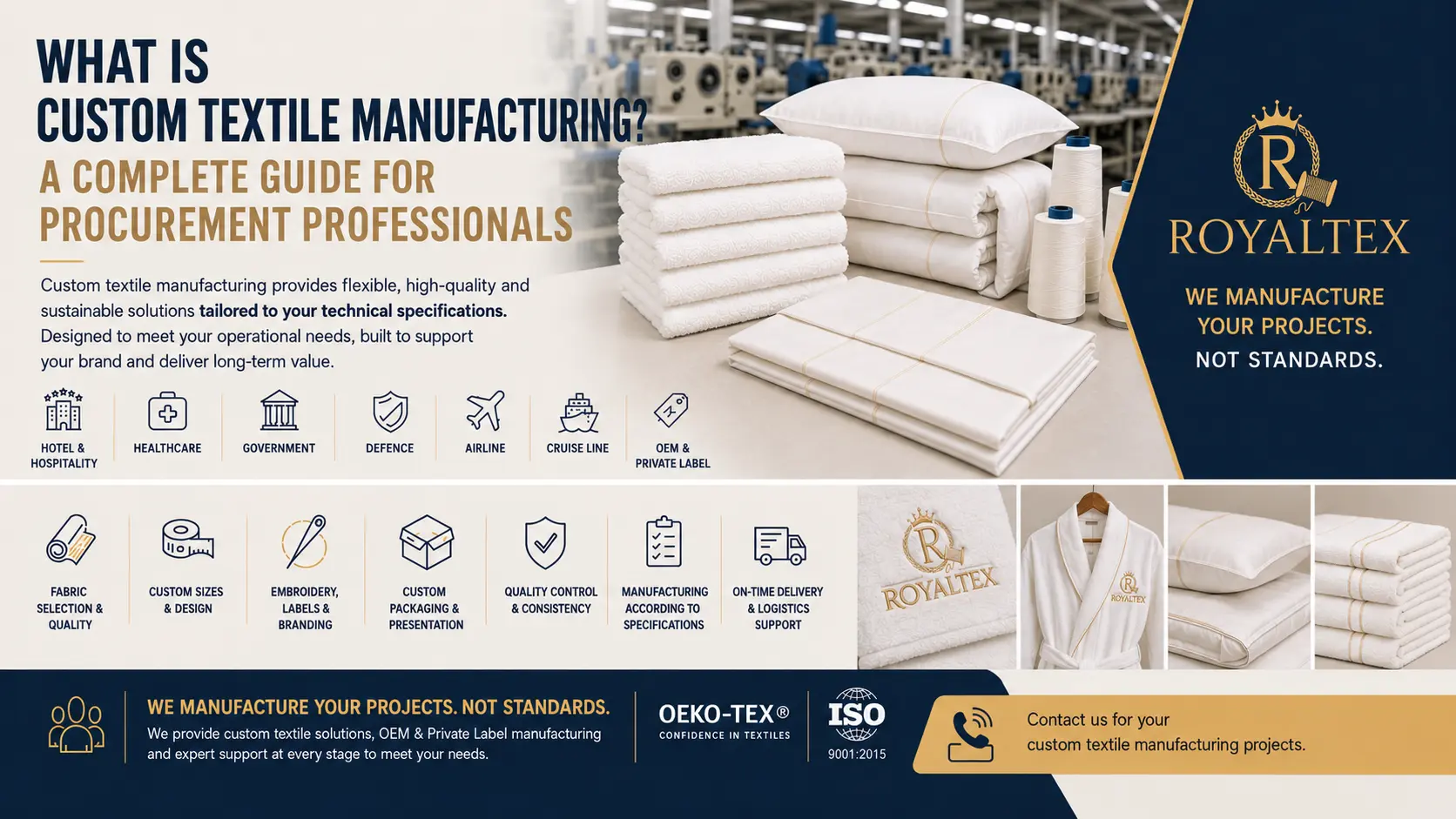
Hotels, healthcare providers, cruise operators, government institutions, airlines, defence organisations and facility management companies all operate under unique technical specifications, operational requirements and procurement standards. As projects become more complex, organisations increasingly require textile products that are manufactured specifically for their application rather than adapted from standard collections.
This is where custom textile manufacturing becomes essential.
Instead of offering predefined products, custom textile manufacturers develop and produce textile solutions based entirely on customer specifications. Every aspect of production—from fabric construction and yarn quality to dimensions, branding, packaging and delivery—is tailored to meet the exact needs of each project.
For procurement professionals, this approach provides greater flexibility, improved product consistency and a manufacturing process aligned with long-term operational objectives.
In this guide, we explain what custom textile manufacturing is, how the process works and why project-based manufacturing has become the preferred solution for institutional and commercial buyers worldwide.
⸻
What Is Custom Textile Manufacturing?
Custom textile manufacturing is the process of producing textile products according to a customer’s technical specifications instead of manufacturing standard catalogue products.
Unlike traditional manufacturing, where buyers select from existing product collections, custom manufacturing begins with the customer’s requirements.
These specifications may include:
- Fabric construction
- Fibre composition
- Yarn quality
- GSM (fabric weight)
- Product dimensions
- Stitching methods
- Colour standards
- Embroidery or logo applications
- Woven labels
- Private label branding
- Packaging requirements
- Carton configuration
- Performance requirements
Every production stage is planned around these specifications to ensure the finished product performs exactly as required.
This approach is widely used across industries where consistency, compliance and product performance are critical.
⸻
Why Standard Textile Products Are Not Always Enough
Many procurement projects involve requirements that standard products simply cannot meet.
For example, a hotel group may require bed linen produced in a specific fabric construction to match its brand standards.
A healthcare provider may require products capable of withstanding repeated industrial laundering while maintaining hygiene performance.
A government institution may work with detailed technical documentation that specifies every material and production requirement.
An airline may require textile products designed around limited storage capacity and operational efficiency.
Although each project differs, they all share one characteristic:
They require manufacturing flexibility rather than standard production.
Custom textile manufacturing allows organisations to source products designed specifically for their operations instead of compromising with off-the-shelf alternatives.
⸻
Industries That Benefit from Custom Textile Manufacturing
Project-based textile manufacturing supports organisations across a wide range of industries.
Common sectors include:
- Hospitality and hotel groups
- Healthcare and medical facilities
- Cruise operators
- Government institutions
- Defence organisations
- Airlines
- Facility management companies
- Corporate procurement organisations
Each sector has different expectations, but all require a manufacturing partner capable of adapting production to technical specifications while maintaining consistent quality and reliable delivery.
⸻
What Can Be Customised?
One of the greatest advantages of custom textile manufacturing is production flexibility.
Depending on project requirements, manufacturers can customise:
- Fabric type and construction
- Fibre composition
- Yarn count and quality
- GSM
- Sizes and dimensions
- Colours
- Embroidery
- Jacquard weaving
- Woven labels
- Printed labels
- Private label branding
- Packaging design
- Carton quantities
- Product presentation
- Retail packaging
- Export packaging
This flexibility enables procurement teams to purchase products designed specifically for their operational needs rather than adapting existing products.
⸻
The Custom Textile Manufacturing Process
Although every project is unique, the manufacturing process generally follows the same structure.
1. Technical Specification Review
Customer requirements are analysed in detail.
2. Product Development
Materials, construction and production methods are determined.
3. Sampling
Prototype samples are manufactured and evaluated.
4. Production Planning
Production schedules and quality procedures are established.
5. Manufacturing
Products are manufactured according to approved specifications.
6. Quality Control
Quality inspections are performed throughout production.
7. Packaging and Worldwide Delivery
Products are packed according to customer requirements before international shipment.
This structured approach helps ensure consistency across every production batch.
⸻
Benefits of Working with a Custom Textile Manufacturer
Choosing a project-based manufacturing partner offers several long-term advantages.
These include:
- Products developed specifically for operational requirements
- Greater flexibility during product development
- Consistent quality across production batches
- Simplified procurement processes
- Better brand consistency
- Reliable long-term supply
- International shipping capabilities
- Scalable production for future projects
Rather than adapting projects to standard products, procurement teams gain the flexibility to purchase products developed specifically for their organisation.
⸻
Choosing the Right Manufacturing Partner
Selecting a textile manufacturer involves much more than comparing prices.
Procurement professionals should evaluate several important factors, including:
- Technical manufacturing capability
- OEM and Private Label experience
- Quality management systems
- OEKO-TEX® and ISO standards
- Production flexibility
- Communication throughout the project
- Export experience
- Ability to manufacture according to technical documentation
A reliable manufacturing partner should be capable of supporting the entire project lifecycle—from specification review to worldwide delivery.
⸻
Conclusion
As procurement requirements continue to evolve, custom textile manufacturing has become an increasingly valuable solution for organisations seeking flexibility, quality and long-term supply reliability.
Rather than relying on standard product catalogues, procurement teams are choosing manufacturing partners capable of adapting production to their exact technical specifications and operational objectives.
Project-based manufacturing not only improves product performance but also creates stronger, more efficient procurement processes over the long term.
If your organisation requires textile products manufactured according to your own specifications, working with an experienced OEM and Private Label manufacturer can provide the flexibility and consistency needed for successful institutional and commercial projects.
Learn more about our Custom Textile Manufacturing Solutions and discover how Royaltex supports procurement teams with project-based textile manufacturing tailored to customer specifications.
Need textile products manufactured according to your technical specifications?
Contact Royaltex to discuss your OEM, Private Label and project-based textile manufacturing requirements.